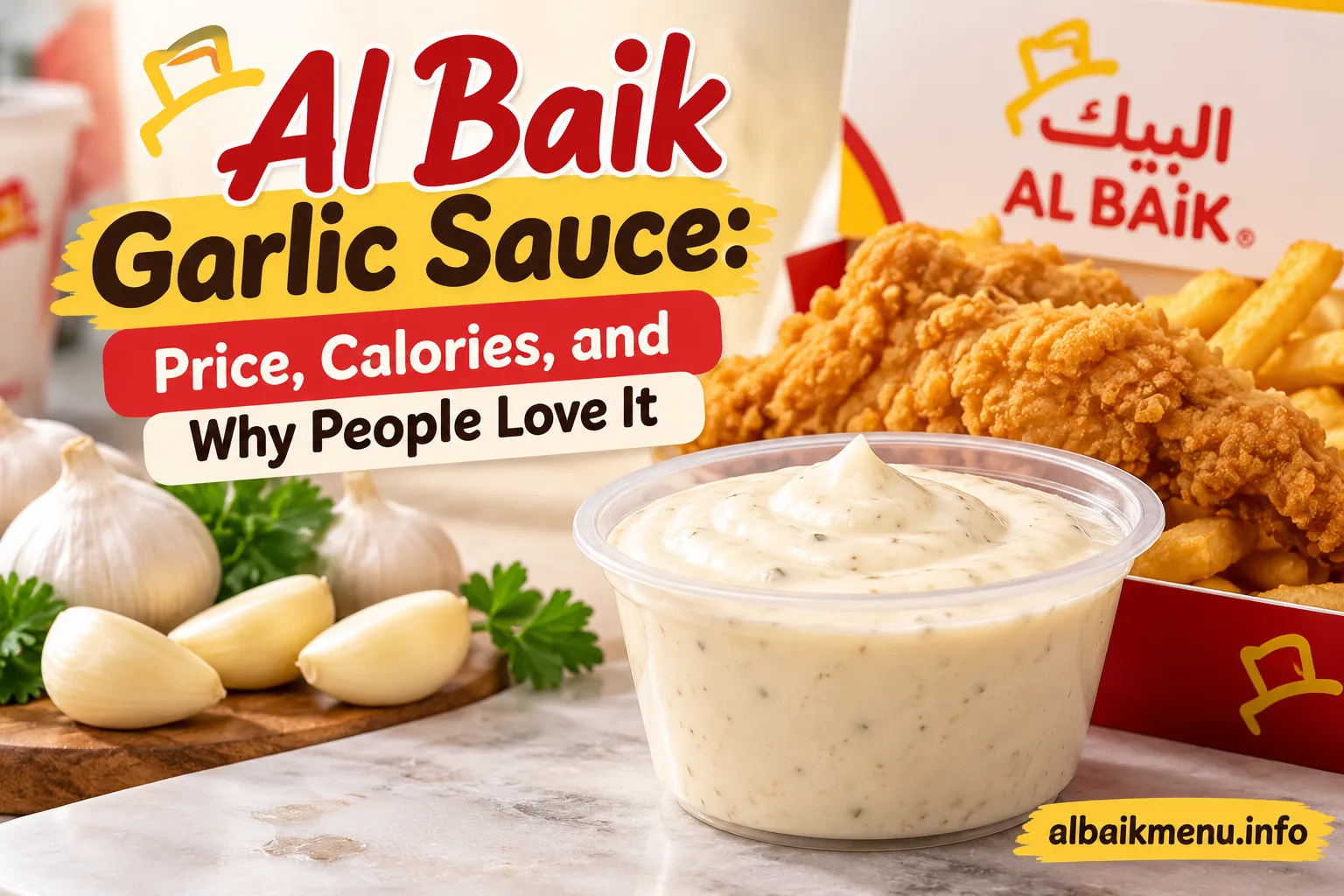
Al Baik Garlic Sauce: The Most Famous Condiment in Saudi Arabia
Ask any Saudi expat what they miss most about home and, more often than the food itself, they’ll mention the sauce. Not the chicken, not the fries — the small white plastic packet that comes with almost every order at Al Baik, and that has somehow become more iconic than the restaurant chain that serves it. There are people who have flown Al Baik boxes internationally in checked luggage. There are people who’ve asked family members visiting from Jeddah to bring nothing but extra sauce packets. That’s not normal condiment behavior — and it’s worth actually unpacking why.
Why the Sauce Became Bigger Than the Brand
Al Baik has never run a major international ad campaign, and the brand still doesn’t need one — its reputation has spread almost entirely through people talking about the food, and the garlic sauce is consistently the first thing that comes up. It’s a genuinely rare thing in the fast-food industry: a condiment that customers talk about with more enthusiasm than the main dish it’s meant to accompany. Reviews across TripAdvisor and Google consistently single it out by name, independent of whatever specific meal the reviewer ordered — chicken, fish, nuggets, sandwiches, it doesn’t matter. The sauce gets mentioned regardless.
Part of what makes this notable is that garlic sauce, as a category, isn’t unique to Al Baik. Toum — the Levantine garlic emulsion the sauce is broadly related to in style — exists across the region in various forms at countless restaurants. What Al Baik has managed to do is turn its specific version into a brand asset as recognizable as its chicken, to the point where “Al Baik sauce” functions almost as its own product identity separate from the restaurant.
What’s Actually In It (And Why Nobody Really Knows for Certain)
Here’s the honest answer: Al Baik has never published an official ingredient breakdown or exact recipe, and that’s almost certainly intentional. Like most iconic fast-food sauces worldwide — think of the mystery around McDonald’s special sauce or KFC’s eleven herbs and spices — the appeal is partly built on the fact that it can’t be perfectly replicated at home, no matter how many people try.
What can be said with reasonable confidence, based on its taste profile and its resemblance to Levantine and Gulf-style garlic emulsions, is that the base almost certainly involves garlic, a neutral oil, an acid component (commonly lemon juice in traditional toum-style preparations), and likely an emulsifying element to give it that thick, mayo-adjacent texture rather than a thin garlic oil. Beyond that, the exact ratios, any additional flavoring agents, and the specific preparation method remain proprietary — and any recipe claiming to be the “real” Al Baik formula circulating online should be treated as an approximation at best, not a confirmed replica.
Why People Describe It as “Addictive” — The Actual Explanation
The word “addictive” comes up constantly in reviews and social media posts about the sauce, and while that’s obviously not meant in a literal chemical dependency sense, there’s a real flavor-science explanation for why it hits the way it does. Garlic-forward sauces with a creamy, emulsified texture tend to hit multiple taste receptors at once — the pungency and slight sharpness of raw or lightly processed garlic, balanced against fat from the oil base and acidity from the citrus component. That combination — sharp, creamy, and acidic simultaneously — is a well-documented pattern in craveable condiments generally (it’s part of why garlic aioli and similar sauces are popular well beyond Saudi Arabia). Al Baik’s specific balance of those three elements, whatever the exact ratio, appears to land in a sweet spot that a huge number of people find genuinely hard to stop eating.
There’s also a simpler explanation worth not overlooking: repetition and association. For millions of people, this sauce is tied to specific memories — post-Umrah meals near the Haram, family dinners, road trips — and the flavor itself becomes wrapped up in nostalgia over years of repeated exposure. That emotional association is a real, if less scientific, part of why the craving feels so strong for longtime customers specifically.
How to Store It Properly at Home
If you’ve picked up extra sauce packets or a larger container, a few practical points on keeping it fresh:
Refrigerate immediately if not using within a couple of hours. Garlic-based sauces with an oil and dairy-adjacent emulsion (if any dairy component is present, which isn’t officially confirmed) spoil faster at room temperature than more stable condiments like ketchup, particularly in Saudi Arabia’s climate.
Keep sealed packets sealed until use. The individual packaging is designed to preserve freshness until opened — once opened, treat it like any fresh, unpreserved sauce and use it within a day or two, refrigerated.
Don’t freeze it. Emulsified sauces with an oil base tend to separate and lose their texture when frozen and thawed, so freezing extra sauce isn’t a reliable way to extend its life — better to buy what you’ll actually use within a short window.
Watch for separation as a freshness signal. If a stored container starts visibly separating into oil and solids beyond what a quick stir can fix, that’s generally a sign it’s past its best and shouldn’t be used.
Creative Ways People Actually Use It Beyond Chicken
Loyal customers have found plenty of uses for the sauce well outside its original context, and it’s worth mentioning a few since it says something about how versatile the flavor profile actually is:
- As a shawarma or grilled meat condiment, standing in for traditional toum in home cooking.
- Mixed into rice dishes for an extra hit of garlic flavor alongside kabsa or biryani.
- As a dip for plain bread or vegetables, independent of any meal at all.
- Spread on sandwiches in place of mayonnaise for a sharper, more pungent flavor.
None of these are official recommendations from the brand — they’re just patterns of how genuinely devoted customers have extended the sauce’s life beyond a single meal.
Why This Matters Beyond Just “It Tastes Good”
The garlic sauce is arguably the single strongest piece of evidence for how Al Baik built a cultural following without conventional marketing. A restaurant chain doesn’t get its condiment smuggled across borders in luggage, referenced constantly in reviews independent of the actual meal ordered, and discussed with this level of specificity by people who’ve never worked in food service, purely by accident. It’s a genuinely rare example of a fast-food side item becoming as culturally significant as the main product — and understanding why gives a much clearer picture of what actually built Al Baik’s reputation over five decades, versus what a typical marketing campaign would try to manufacture from scratch.
Frequently Asked Questions
What is Al Baik garlic sauce made of? The exact recipe is proprietary and has never been officially published. Based on flavor and texture, it’s broadly similar to Levantine-style garlic emulsions (toum), likely built around garlic, oil, an acid component, and an emulsifier, though the precise formula remains unconfirmed.
Can I buy Al Baik garlic sauce separately without ordering food? Sauce is typically sold in different container sizes alongside meal orders, both in-branch and through delivery platforms, rather than as a standalone retail product on supermarket shelves.
How long does Al Baik garlic sauce last once opened? It should be refrigerated and used within a day or two of opening, given its likely oil and garlic-based composition, which spoils faster than shelf-stable condiments.
Why do people say Al Baik’s sauce is better than similar garlic sauces elsewhere? This comes down to a combination of a well-balanced flavor profile (sharp, creamy, and acidic together) and decades of brand association and nostalgia, rather than any single confirmed ingredient that sets it apart.
The Toum Connection: Understanding the Broader Sauce Family
To really understand what makes Al Baik’s garlic sauce distinctive, it helps to zoom out and look at the broader culinary tradition it belongs to. Toum, the Levantine garlic sauce it’s most closely related to in style, has existed for generations across Lebanon, Syria, Jordan, and Palestine, traditionally made by emulsifying raw garlic with a neutral oil, slowly, the same way you’d build a mayonnaise — a small amount of oil at a time, whisked continuously until the mixture thickens and turns pale white. It’s notoriously difficult to make correctly at home; even experienced home cooks report the emulsion breaking (separating back into oil and garlic solids) if the oil is added too quickly or the garlic isn’t processed finely enough first.
Given that Al Baik’s founder, Shakour Abu Ghazalah, was a Palestinian-Saudi entrepreneur, the culinary through-line from traditional Levantine toum to Al Baik’s version isn’t a coincidence — it’s a direct reflection of the founder’s own regional food heritage, adapted and refined into what eventually became a distinctly Saudi fast-food staple. That origin story is part of why so many people from across the Levant instantly recognize the flavor family even if they’ve never specifically had Al Baik’s version before.
Attempts to Recreate It: What Actually Works and What Doesn’t
Countless home cooks and food bloggers have attempted to reverse-engineer the sauce, with wildly varying results. A few patterns show up consistently across serious attempts:
Garlic quality and preparation matter enormously. Using fresh, high-quality garlic cloves rather than pre-minced jarred garlic tends to produce a noticeably closer result, since pre-processed garlic often carries a different, sometimes bitter, flavor profile compared to fresh cloves processed just before use.
Oil choice affects both flavor and texture. A neutral, mild oil (rather than a strongly flavored olive oil) tends to let the garlic and acid components come through more clearly, which is closer to how commercial fast-food garlic sauces are typically formulated for consistency and shelf stability.
Patience during emulsification is non-negotiable. Rushing the process — adding oil too quickly while blending — is the single most common reason home attempts fail to achieve the right thick, creamy texture and instead end up thin or separated.
None of this produces an exact replica, and it’s worth being upfront about that. But understanding the general technique explains why the sauce is genuinely difficult to casually recreate at home, which is part of what keeps people going back to the original rather than settling for a homemade version.
The Business Logic Behind Never Publishing the Recipe
From a brand strategy standpoint, keeping the exact formula proprietary is a well-established pattern among iconic food brands worldwide, and it serves a specific purpose beyond simple secrecy. A signature, unreplicable flavor gives customers a reason to keep returning to the original source rather than substituting a homemade or competitor version, which is precisely why brands with famously guarded recipes — from Coca-Cola’s formula to KFC’s spice blend — have maintained that secrecy for decades even as pressure to disclose ingredients has grown. For Al Baik specifically, given how central the sauce has become to the entire brand identity, protecting that formula isn’t just tradition — it’s arguably one of the most valuable pieces of intellectual property the company holds.
Frequently Asked Questions (Continued)
Is Al Baik’s garlic sauce spicy? The standard version is not particularly spicy — it’s primarily garlic-forward with creamy and tangy notes. Al Baik does offer separate spicier sauce and chicken options (sometimes referred to as “Harra” or spicy variants) for customers who want more heat, distinct from the classic garlic sauce itself.
Can I request extra garlic sauce with my order? Extra sauce portions are typically available to add on, either through the app’s customization options or by asking directly at the counter, sometimes for a small additional charge depending on quantity.
Is the garlic sauce vegetarian? Based on its likely composition (garlic, oil, acid, and an emulsifier), it’s generally understood to be vegetarian-friendly, though anyone with specific dietary restrictions or allergies should confirm directly with branch staff, since the exact official ingredient list isn’t published.
Why does the sauce taste slightly different at different branches? This shouldn’t happen if quality control is consistent, and most customer reports suggest it generally is — but minor variation can occur due to batch freshness or storage conditions at a specific branch. Consistent taste across branches has historically been one of Al Baik’s most frequently praised operational strengths.
Related Albaik guides
- Albaik menu with prices (Saudi Arabia)
- Albaik calorie counter
- Albaik best sellers ranked
- منيو البيك بالأسعار
Eating it with spicy broast? Here is how Al Baik spicy chicken compares with the regular version.